Shipping container modifications — what is safe to cut and what is not
Doors, windows, roller doors, lining, insulation, power and shelving: what can safely be cut into a shipping container, what carries load, and when to buy new.
Guide · 8 min read
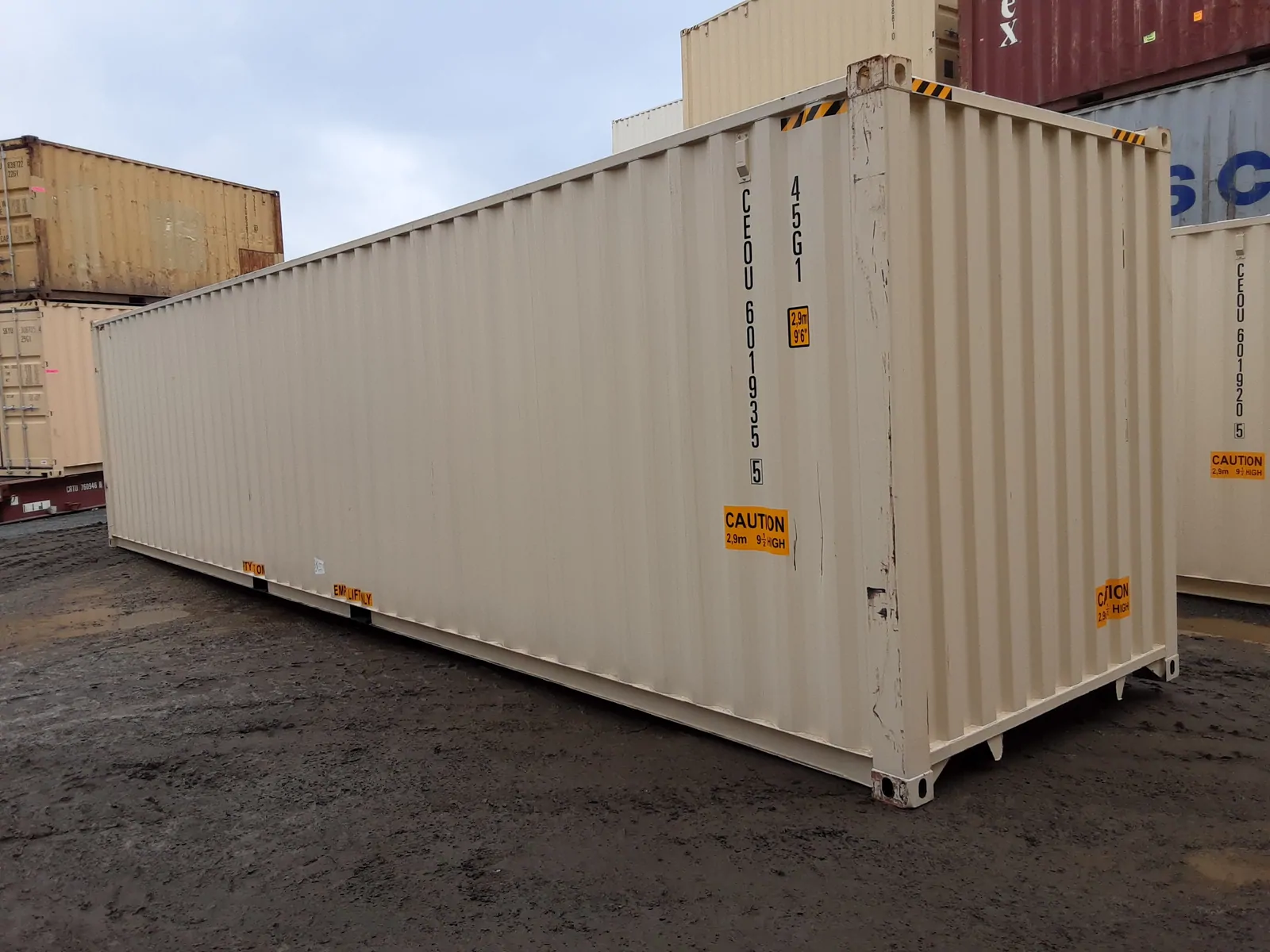
The 40ft holds roughly twice as much as the 20ft and does not cost twice as much, which makes it look like the obvious buy on paper. Then it has to get onto your block. Here is the comparison without the sales gloss, including the cases where two 20fts are the better answer and the cases where they are not.
Both containers are the same width and, in general purpose form, the same height. The only dimension that changes is length. That sounds simple and it is, right up until the truck has to get in.
| 20ft general purpose | 40ft general purpose | |
|---|---|---|
| External length | 6.06 m | 12.19 m |
| External width | 2.44 m | 2.44 m |
| External height | 2.59 m | 2.59 m |
| Internal length | 5.90 m | 12.03 m |
| Internal width | 2.35 m | 2.35 m |
| Internal height | 2.39 m | 2.39 m |
| Door opening | 2.34 m wide, 2.28 m high | 2.34 m wide, 2.28 m high |
| Cubic capacity | 33.2 m³ | 67.7 m³ |
| Tare weight | approx 2,200 kg | approx 3,800 kg |
| Floor area | approx 13.9 m² | approx 28.3 m² |
Note the tare figures. The 40ft holds twice the volume but weighs well under twice as much empty, because a container is mostly a frame with skin stretched over it and the frame does not double. The full reference for every size, including high cubes, is on the dimensions page.
We are not going to put figures in a guide, because they move with grade, condition and availability, and the number that matters to you is the one on your quote. But the shape of it is consistent and worth understanding.
Per cubic metre of storage, the 40ft is the cheapest container on the market, the 20ft sits above it, and the 10ft sits well above that. Buying a 40ft rather than two 20fts of the same grade will always be the cheaper way to acquire the same volume, and it will usually be the cheaper way to have it delivered as well, because one delivery is one delivery.
Compare the actual current numbers side by side on our 20ft and 40ft pages. The gap is real and it is the reason people talk themselves into the bigger box.
Volume per dollar is only one of the numbers in this decision. The others are all about the site.
A 20ft delivered on a tilt-tray wants roughly twenty metres of straight, level run behind the placement spot. A 40ft on a tilt-tray wants a lot more than that, and the truck itself is longer, so the turn off the street is harder as well. Plenty of suburban blocks that take a 20ft without drama simply cannot take a 40ft on a tilt-tray at all.
The workaround is a side loader or a crane truck, both of which handle 40fts routinely. A side loader does not need a run-in — but it sets the container down off its right-hand side, the driver's side, so the truck has to be able to stand with that side facing the spot. On a narrow street, a one-way street or a driveway that can only be approached from one direction, that is not always possible. The delivery page goes through what each truck needs.
Twelve metres is a long object. On a standard residential block it will often cross the whole depth of the backyard or run past a boundary setback. It fixes the shape of the site around it in a way a 20ft does not. Before deciding, peg twelve metres out on the ground and stand back. People are routinely surprised.
If you ever need to shift it — a new shed going in, a subdivision, a move, a sale — a 40ft is a bigger, more expensive, more restricted job than a 20ft, and the number of yards and trucks that can handle it is smaller. That is a cost you will not see on day one.
The second-hand market for 20fts is deep. Almost anyone can take one. The market for 40fts is thinner, because the same access problem that applies to you applies to the next buyer. If you expect to sell it on in a few years, that matters.
The choice is not binary. If the honest answer is that you need somewhere lockable for a mower, a compressor and a rack of hand tools, a 10ft will do it, fit through a gap a 20ft cannot, and leave your yard usable. It costs more per cubic metre and is worth every cent when the alternative does not fit.
In the other direction, a high cube adds 300 mm of internal height for a modest premium and no extra footprint. If you are storing anything tall, racking anything, or thinking about a fit-out where the ceiling will come down once you line it, the high cube is usually the better buy at either length. It is taller to deliver, though, so check overhead clearance on the route.
If you are not sure, send us three photographs — from the road looking in, from the placement spot looking back out, and a wide shot of the spot itself. That is usually enough for us to tell you what will physically go in there. Ring 0477 410 500 and we will talk it through.
More guides
Doors, windows, roller doors, lining, insulation, power and shelving: what can safely be cut into a shipping container, what carries load, and when to buy new.
How to secure a shipping container properly: lock boxes, the right padlock, where to point the doors, lighting and sight lines, and a realistic view of risk.
When shipping container hire makes sense and when buying does, how to find your own break-even, what to check in a hire agreement, and the cost of moving one.
Get a price
Ring us — 0477 410 500 — or send it through. Every enquiry answered within one business day.
Or skip the form and ring us — 0477 410 500, Mon–Fri 7:30am–5pm, Sat 8am–12pm